

We use cookies to improve your online experiences. To learn more and choose your cookies options, please refer to our cookie policy.

15 October, 2026
How Trilingual Education Works and Why It Matters for Your Child

Barcelona offers something that very few cities in the world can match: the possibility of growing up fluent in three major languages. English, Spanish, and Catalan are all present in daily life here, and for children at the right school, all three become languages they use with ease.
This article explains how trilingual education works in practice, what the research says about its long-term benefits, and why it matters more than many families initially realise when choosing a school in Barcelona.
What does trilingual education actually mean?
Trilingual education means that children learn and use three languages as part of their everyday school experience, not just as timetabled subjects. The distinction matters. A child who has three language lessons a week is learning about languages. A child who is taught science in English, has literature in Spanish, and plays with friends in Catalan is living in three languages. The outcomes are very different.
In a genuinely trilingual school, all three languages are embedded across the curriculum and the school day. Children switch between them naturally, use them for real purposes, and build fluency through meaningful interaction rather than isolated formal study.
At Hamelin-Laie, English, Spanish, and Catalan are all part of everyday school life. Children do not experience language as a lesson to be endured but as a natural part of how they learn, communicate, and connect with each other.
Why does it matter which languages a child learns and when?
The age at which children are exposed to additional languages has a significant bearing on how fluently they acquire them. Research consistently shows that the earlier children encounter a language in a meaningful, immersive context, the more naturally they develop native or near-native fluency.
A landmark study by Kuhl, Tsao, and Liu (2003), published in the Proceedings of the National Academy of Sciences, found that early exposure to multiple languages not only produces better language outcomes but also enhances the brain's ability to process and distinguish sounds across all languages the child encounters. In short, learning languages early makes learning more languages easier.
Barcelona, and a trilingual school within it, gives children that early exposure in the most effective possible way: through real life, real relationships, and real communication.
What are the long-term advantages of growing up trilingual?
University and career opportunities
The professional value of multilingualism is well documented and growing. English remains the global language of business, science, and higher education. Spanish is the second most spoken language in the world by native speakers, with more than 480 million speakers across 20 countries. Catalan, while more regionally specific, signals cultural fluency and integration in Catalonia, which matters for families building long-term lives in the region.
Children who leave school fluent in all three languages carry a major advantage into university applications and into the job market. They are not just ticking a language box on a CV. They are demonstrating cognitive flexibility, cultural intelligence, and the ability to operate across contexts – qualities that employers and universities increasingly value.
Cognitive benefits
The cognitive advantages of bilingualism and multilingualism are among the most consistently replicated findings in educational research. Studies show that children who grow up using multiple languages develop stronger executive function, including better attention control, task switching, and the ability to filter out irrelevant information.
A review by Bialystok, Craik, and Luk (2012), published in Trends in Cognitive Sciences, found that multilingual individuals show measurable cognitive advantages across their lifespans, from childhood through to old age. The mental effort of managing multiple language systems appears to strengthen the brain's capacity for complex reasoning and problem-solving.
For children at an international school in Barcelona, these benefits develop not through deliberate cognitive exercise but through the natural experience of living and learning in multiple languages every day.
Social and cultural intelligence
Language is not just a communication tool. It is a window into how people think, what they value, and how they understand the world. Children who grow up fluent in multiple languages tend to develop a more nuanced understanding of other cultures, greater empathy for people from different backgrounds, and a more flexible sense of identity.
In a city as diverse as Barcelona, and at an international school where students come from dozens of different countries, these social and cultural skills develop naturally alongside linguistic ones. Children learn to navigate difference, find common ground, and communicate across cultures. Everyday interactions teach these skills in a way that no classroom exercise alone can replicate.
Adaptability and resilience
Multilingual children are, by definition, children who have had to adapt. They have learned to read a room, adjust their communication style, and operate in contexts that are not entirely familiar. This builds a kind of social adaptability that serves them well throughout life, particularly in environments that value collaboration, creativity, and cross-cultural communication.
How does trilingual education work at different stages of school?
Early Years and Primary
In the Early Years, language acquisition happens through play, song, story, and social interaction. Children at this stage absorb language with remarkable efficiency when they are immersed in it. A trilingual environment at this stage does not confuse children, as some parents worry. Research shows that children separate their languages very early and use them appropriately for different contexts and relationships.
At Hamelin-Laie, the early years programme follows the International Early Years Curriculum, with English as the primary language of instruction alongside Spanish and Catalan integrated naturally into daily life. By the time children move into primary, they are already operating comfortably across all three languages.
Secondary school
By Secondary school, trilingual students have a noticeable academic advantage. They can access source material, engage with teachers and peers, and think and write across three languages. In a world where knowledge increasingly crosses national and linguistic borders, this is a meaningful edge.
At Hamelin-Laie, Secondary students continue to use all three languages across the curriculum as they prepare for the IB Diploma or National Baccalaureate. Both pathways value and reward multilingual competence.
What should parents look for in a trilingual school?
Not every school that describes itself as trilingual delivers the same outcome. There are a few things worth looking for when evaluating schools.
Languages should be used across the curriculum, not just in dedicated language lessons. Ask how many subjects are taught in each language and how this is structured across year groups.
Teachers should be native or highly proficient speakers of the languages they teach. Language fluency is caught as much as it is taught, and children pick up accent, idiom, and naturalness from the adults around them.
The school community should reflect the linguistic environment. A school where students predominantly socialise in one language outside the classroom will not produce the same outcomes as one where multiple languages are genuinely present in daily life.
Ask about language assessment and support. A good trilingual school will have clear systems for assessing where each child is in each language and supporting those who need additional help, particularly children who arrive with limited Spanish or Catalan.
Is trilingual education right for every child?
The honest answer is that trilingual education suits almost every child, but the transition can take time, particularly for older children joining a school where they have limited prior exposure to one or more of the languages.
Younger children adapt fastest. Children who join in the early years typically achieve strong fluency across all three languages with relatively little difficulty. Children who join in secondary school may find the adjustment more demanding, particularly if they are simultaneously navigating a new academic environment and a new social context.
Good schools manage this carefully. They provide language support, monitor progress, and ensure that children who are still developing their language skills are not disadvantaged academically in the interim. At Hamelin-Laie, language support is built into the school's pastoral and academic structure from the point of arrival.
Barcelona as a trilingual city
One of the things that makes Barcelona unusual is that the trilingual environment does not end at the school gate. Children who live in Barcelona are surrounded by Spanish and Catalan in their daily lives, which means the language learning that happens at school is constantly reinforced outside it.
This is a key advantage over families who pursue bilingual or trilingual education in cities where only one of the target languages is present in the wider community. In Barcelona, the city itselfbecomes an extension of the classroom.
Research published in the journal Language Learning (Paradis, 2011) found that children acquireadditional languages most effectively through meaningful, repeated social interaction rather than formal instruction alone. For families in Barcelona, that interaction is everywhere.
Taking the next step
If you are considering an international school in Barcelona and want to understand more about how trilingual education works in practice, the best thing to do is visit a school and see it for yourself. Watching children move naturally between languages in a real school environment is more convincing than any article.
At Hamelin-Laie, we would be happy to show you how trilingual learning works across our school and answer any questions you have about how your child would be supported.
----
P.K. Kuhl,F. Tsao, & H. Liu, Foreign-language experience in infancy: Effects of short-term exposure and social interaction on phonetic learning, Proc. Natl. Acad. Sci. U.S.A. 100 (15) 9096-9101, https://doi.org/10.1073/pnas.1532872100 (2003).
Paradis, J. (2011). Individual differences in child English second language acquisition. Language Learning, 61(S1), 189-220.
Bialystok E, Craik FI, Luk G. Bilingualism: consequences for mind and brain. Trends Cogn Sci. 2012 Apr;16(4):240-50. doi: 10.1016/j.tics.2012.03.001. PMID: 22464592; PMCID: PMC3322418
Related news
News image ![A Global Community Where Families Feel They Belong - International Potluck 2026]() Blog
Blog
 Blog
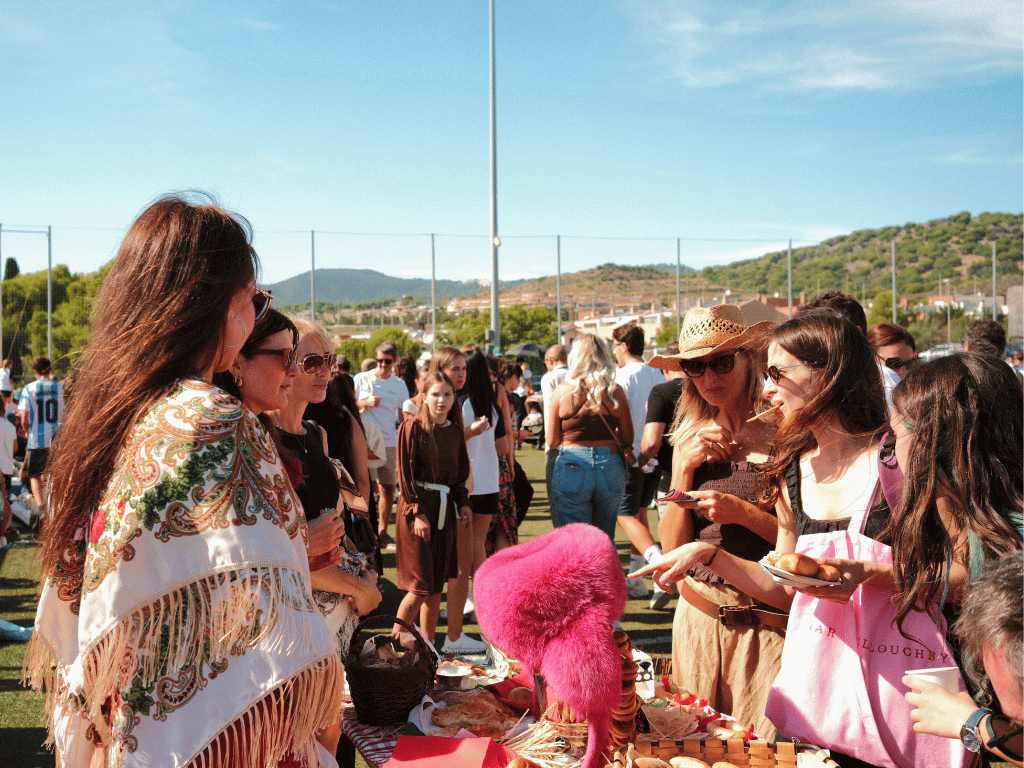
Blog A Global Community Where Families Feel They Belong
Explore how Hamelin-Laie International School in Barcelona fosters belonging, cultural diversity and meaningful family connections through its international community and annual International Potluck.
News image ![What to Expect in the First Weeks at an International School in Barcelona - What to Expect in the First Weeks at an International School in Barcelona]() Blog
Blog
 Blog
Blog What to Expect in the First Weeks at an International School in Barcelona
A guide for parents starting at Hamelin-Laie


